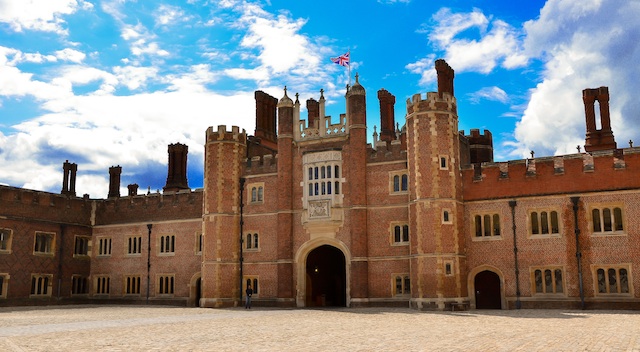
Happy Saturday evening everyone! My next stop in my “On Location” travelogue is to take a look at the site of many film and television productions – the historic royal Hampton Court Palace.
The former residence of kings has gained legendary status due to its association with the Tudor dynasty. For a little more about the history of the palace, watch the video below.
Here is a list of feature films shot at the landmark in East Molesey, Surrey.

Sherlock Holmes: A Game of Shadows (2011)- Pirates of the Caribbean: On Stranger Tides (2011)
- The New World (2005)
- Jack the Giant Killer (2012)
- The Young Victoria (2009)
- Amazing Grace (2006)
- The Libertine (2004)
- Vanity Fair (2004)
- A Man for All Seasons (1966)
- Stage Beauty (2004)
- To Kill a King (2003)
- Baby Love (1968)
- Three Men in a Boat (1956)
Source: Internet Movie Database (IMDB)
In addition, television productions that have filmed at the palace include the renowned:
- Little Dorrit (2008)
- John Adams (2008)
- The Six Wives of Henry VIII (2001)
On a personal note, my trip out to the palace was highlighted by an audience with the man himself – King Henry VIII. Unfortunately I do not have any photos of that …





Response to Blog I Saw Over the Holiday
This is in response to a blog posting I saw featured on the site Cinematical entitled What Makes British Actors So Versatile?
I decided to take a general look at the theory that is postulated and came up with the following points:
Best of the Best: I generally agree with comment from a user regarding getting the “cream of the crop” of British screen talent. I watch plenty of British TV and you soon realize that there is definitely getting range of observable talent.
Language: from an American perspective, we often think of the versatility of British actors mostly having to do with donning an American accent. While many do succeed, a lot do fail to pull off a convincing accent, especially when the role hones in on a particular U.S. region.
Versatility, Part II: As stated above, many Americans may be amazed by the ability of actors to affect an accent not native to them. This is definitely a skill, but not the only skill we should look at when defining versatility. To be versatile does cover a large array of skills, including but not limited to: the ability to perform in a variety of genres, (as mentioned in the article) the ability to physically change one’s appearance, etc. With this broader definition, we may discover that the list of truly versatile performers is very exclusive, without respect to where they are from.
The UK film and theater industries: in many ways, the UK film industry, relative to the juggernaut of the Hollywood system, is a cottage industry. As a result, I suspect this forces many more aspiring actors to focus on drama and theatrical training, given the tradition and prominence of “treading the boards” in the UK. This extra training also allows the actor in training to spend time developing and honing their skills “off camera.” So when they are “camera-ready, the results speak for themselves.
In contrast, the Hollywood system is primarily focused on star-making; this relies a little more on superficial qualities and talent can be sacrificed for popularity, likability or perceived attractiveness.
—-
It should be noted as several commenters to the original article noted, we must be careful about the generalization many of us make (including myself) of grouping all actors from that part of the world as simply “British.”
—-